
Where Can I Get a Document Notarized? 8 Options
Banks, shipping stores, mobile notaries, law offices, libraries and online platforms all notarize documents. Here is what each option costs, when it is open, and which one is fastest.
Have your document ready?
Get it notarized online in about 10 minutes — $25, 24/7, no account needed.
Notarize now — $25Key Takeaways
- •Documents can be notarized at banks and credit unions, UPS Stores, FedEx Office locations, independent notaries, mobile notaries, law offices, some libraries and government offices, or online by video.
- •Bank and credit union notarization is frequently free for account holders, but availability is decided branch by branch, so call before you travel.
- •UPS Store and FedEx Office notary service depends on the individual location, since stores are independently operated or staffed locally.
- •Notaron notarizes online for $25 per session, 24/7, with no account required and a typical session lasting about 10 minutes.
- •Bring the unsigned document, an unexpired government photo ID, all signers, and any required witnesses to any notarization, in person or online.
- •Notaries generally cannot serve as your witness; Notaron supplies a witness for $10 per witness in a remote session.
- •Whether a document can be notarized remotely depends on state law and on the receiving party, so check eligibility before starting.
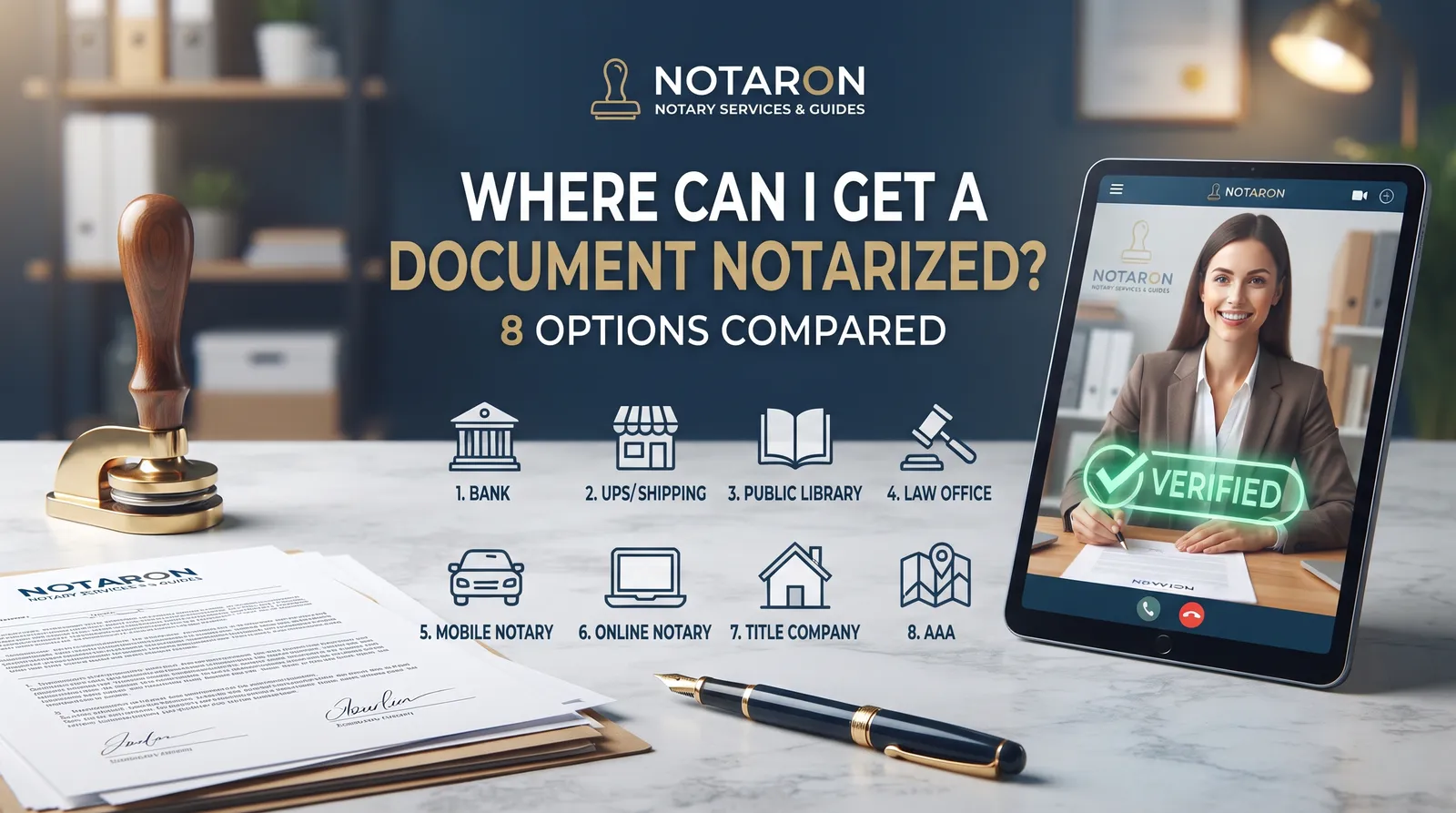
Where can I get a document notarized? The 8 options compared
You can get a document notarized at a bank or credit union branch, a UPS Store, a FedEx Office location, an independent notary's office, through a mobile notary who travels to you, at a law office, at some public libraries and government offices, or online by video. Banks and credit unions frequently notarize at no charge for their own account holders; online notarization lets you meet a commissioned notary over secure video without leaving your desk. Notaron charges $25 per notarization session, runs 24/7, and a typical session takes about 10 minutes.
Remote online notarization (RON) means the notary and signer appear together by live audio-video rather than in the same room. Every other option on this list requires you to be physically present with the notary.
| Option | Typical cost | When it is open | Best for |
|---|---|---|---|
| Bank or credit union | Often free for account holders | Branch hours, weekdays | Simple forms during business hours |
| UPS Store | Fee varies by franchise location | Retail hours, some Saturdays | Walk-in convenience |
| FedEx Office | Varies; not every location staffs a notary | Retail hours | Print-and-sign in one trip |
| Independent notary office | State-regulated fee per act | By appointment | Documents needing a specialist |
| Mobile notary | Notary fee plus a travel fee | Evenings and weekends by arrangement | Hospitals, care homes, signers who cannot travel |
| Law office | Often bundled into legal fees | Weekdays by appointment | Documents a lawyer is already drafting |
| Library or government office | Free or low cost where offered | Limited hours, often limited days | Residents near a participating location |
| Online notarization (Notaron) | $25 per session | 24/7, including nights and weekends | Deadlines, travel, multi-state signers |
Notary fees for in-person acts are capped by state law in many states, and the cap differs from state to state, so the same signature can cost a different amount depending on where you stand.
Where can I get something notarized for free?
The most common free options are your own bank or credit union, an employer that keeps a notary on staff, and some public libraries, county clerk offices and city halls. Free almost always comes with a condition: you have to be a customer, an employee, or a resident, and you have to arrive during limited hours.
Free also does not mean complete. A free branch notary will not provide a witness, will not notarize a document you have not finished filling in, and will not stay late if your signer is in another time zone. If your document needs one or two witnesses, factor that in before assuming the trip is free — a remote session can add a witness to a remote online notarization for $10 per witness rather than sending you looking for two neighbors.
A useful way to think about it: free service is cheapest when your document is simple, local and not urgent. As soon as a second signer, a witness, a deadline or a business trip enters the picture, the cheapest option and the least expensive option stop being the same thing.
Will my bank notarize a document?
Many banks and credit unions keep at least one commissioned notary on staff and offer notarization to account holders, frequently at no charge. Notary availability is set branch by branch, not by a single nationwide rule, so the honest answer for any specific branch is: call that branch and ask before you drive there. Ask three questions — is a notary in today, do I need an appointment, and do you notarize this type of document.
Banks also decline more often than people expect. Branch staff commonly turn away real estate documents, wills, and anything the bank's own policy flags as high risk, and they generally cannot serve as witnesses to the signature they are notarizing.
Chase
Notary availability at Chase branches is determined locally and varies by location and staffing. Use Chase's own branch locator or phone the branch directly to confirm a notary is on site that day, and ask whether the service is limited to Chase customers.
Bank of America
Bank of America branches likewise staff notaries at some locations and not others, and appointment policies differ. Bank of America publishes an appointment scheduling tool for branch services; confirm notary availability on the appointment itself rather than assuming any branch can help.
Wells Fargo
Wells Fargo branch notary service also depends on the individual branch and the staff on duty. Call ahead, confirm whether the branch limits notarization to account holders, and ask specifically about your document type if it involves property, estate planning, or a loan.
Notaron does not speak for any bank and has no affiliation with these institutions. Branch policies change without notice, which is exactly why a phone call beats a wasted trip.
Can UPS or FedEx notarize documents?
Shipping and print retailers are the default fallback when the bank says no, and both chains are franchised or locally staffed, which is why answers differ from one storefront to the next.
UPS Store
Many UPS Store locations offer notary services on a walk-in basis, and because each store is independently owned, the fee and the hours are set locally rather than nationally. There is a full breakdown in the Notaron guide to what The UPS Store charges for notary services, including how state fee caps interact with franchise pricing. Call the specific store before you go; a notary being on the schedule is not the same as a notary being behind the counter when you arrive.
FedEx Office
FedEx Office locations focus on printing and shipping, and notary service is not standard at every store. Some locations arrange notarization through a third-party partner rather than a staff notary, which changes both the cost and the wait. The Notaron comparison of a FedEx online notary alternative explains how that arrangement typically works and what it means if your document is time-sensitive.
For both chains, the practical limitation is the same as with banks: retail hours, no witnesses supplied, and no guarantee the person who can notarize is present.
Mobile notaries, law offices, libraries and government offices
A mobile notary is a commissioned notary who travels to your home, office, hospital room or care facility. Mobile notaries usually charge the state-capped notarial fee plus a separate travel fee, and they are the right answer when the signer physically cannot come to a counter. Book ahead; same-day mobile availability is not guaranteed, especially at night.
Law offices notarize routinely, and if an attorney is already drafting your document the notarization is often folded into the engagement. This is also the option to choose when you need legal advice along with a seal — a notary cannot tell you whether your document says what you want it to say. If your document involves an estate plan, a contested matter, or a property interest you are unsure about, talk to a lawyer.
Public libraries, county clerk offices, city halls and some courthouses offer notarization in certain jurisdictions, sometimes free to residents. Hours are narrow, service is often limited to a few days a week, and the range of accepted documents can be restricted. Check the specific location's website or phone line rather than assuming.
Can I get a document notarized online?
Yes. Online notarization — remote online notarization, or RON — lets you meet a commissioned notary over secure live video, verify your identity, sign electronically, and receive a document carrying a tamper-evident digital seal. With Notaron the session runs 24/7, needs no account, and takes about 10 minutes from upload to sealed PDF.
The process at Notaron is short: upload your document as a PDF, verify identity with a government-issued photo ID and knowledge-based authentication questions drawn from public records, meet the notary on video, sign, and download the sealed file. The finished document is legally valid nationwide, and the electronic signature framework behind it is federal and state law rather than platform policy.
Eligibility is the one thing to check before you start. Whether a given document can be notarized remotely depends on state law and on the receiving party — a county recorder, a bank, a foreign consulate or a title agent can impose its own requirements. Run your document through the RON eligibility checker first, and browse what can be notarized online by document type to see how common documents such as powers of attorney, affidavits, and travel consent letters are typically handled. State law varies; check your state's rules.
What do I need to bring to a notary?
Bring the same things whether you are walking into a branch or joining a video session. As of September 2026, the standard checklist is:
- The complete document, unsigned. A notary must watch you sign. If you sign in the car on the way, most notaries will make you start over with a clean copy.
- Valid, unexpired government-issued photo identification. A driver's license, state ID, passport or permanent resident card. Names should match the document.
- All signers. Every person whose signature is being notarized must appear. In a Notaron session, additional signers cost $10 per additional signer.
- Any witnesses the document requires. Notaries generally cannot act as your witness. Notaron can supply a witness for $10 per witness.
- The notarial certificate wording, if the receiving party specified any. An acknowledgment (the signer confirms they signed willingly) and a jurat (the signer swears the contents are true, under oath) are different acts with different wording, and the receiving party usually dictates which one applies.
- Payment. Notaron charges $25 per notarization session, with $5 per additional notarial act on the same document set; the full list is on the Notaron pricing page.
For an online session you also need a device with a camera and microphone and a stable internet connection. For an in-person session you need the physical original.
What's the fastest way to get something notarized?
Online is the fastest route in almost every case, because it removes travel, hours and appointment availability from the equation. A Notaron session runs 24/7, requires no account, and takes about 10 minutes from the moment you upload the PDF. There is no drive, no parking, no "our notary is at lunch".
The ranking, from fastest to slowest in practice:
- Online notarization — minutes, any hour, no appointment.
- Walk-in retail notary — same day if a notary is on duty and the store is open.
- Bank branch — same day for account holders during weekday hours, often by appointment.
- Mobile notary — same day to next day, usually with a travel fee and a scheduling call.
- Law office, library or government office — next available appointment, which can be days out.
If your deadline is today and it is after 5 p.m., the online session is the only option on the list that is definitely open. If your document must be recorded with a county afterward, look at how electronic recording of notarized documents works before you choose, because the recording office's requirements can shape which route is workable.
Your next step
Upload your PDF and meet a commissioned notary now — start an online notarization with Notaron for $25 per session, 24/7, in about 10 minutes.
Frequently Asked Questions
Where can I get a document notarized for free?
The most common free options are your own bank or credit union, an employer with a notary on staff, and some public libraries, county clerk offices or city halls. Free service is usually limited to customers, employees or residents, and only during narrow weekday hours. Free notaries also will not act as your witness and may decline real estate or estate planning documents.
Will my bank notarize a document if I am not a customer?
Many banks and credit unions limit free notary service to account holders, and some decline non-customers entirely. Notary availability is set branch by branch rather than by a single nationwide policy, so call the specific branch and ask whether a notary is on duty and whether non-customers are served. Also ask about your document type, since branches often turn away deeds, wills and loan packages.
Can I get a document notarized online instead of in person?
Yes. Remote online notarization lets you meet a commissioned notary over secure live video, verify identity with a government photo ID and knowledge-based questions, and receive a document with a tamper-evident digital seal. Notaron charges $25 per notarization session, runs 24/7 with no account required, and a typical session takes about 10 minutes. Whether a specific document qualifies depends on state law and on the receiving party.
How much does it cost to get a document notarized?
In-person notary fees are capped per act by law in many states, and the cap varies from state to state, so the price differs by location. Banks often charge nothing for account holders, retail locations set their own fees, and mobile notaries add a travel fee. Notaron charges $25 per notarization session, $5 per additional notarial act on the same document set, $10 per additional signer and $10 per witness.
Does UPS or FedEx notarize documents?
Many UPS Store locations offer walk-in notary service, with fees and hours set by each independently owned franchise. FedEx Office locations do not all staff a notary, and some arrange notarization through a third party instead. In both cases, phone the specific store before travelling, because a notary being scheduled is not the same as a notary being present.
What do I need to bring to a notary appointment?
Bring the complete document unsigned, a valid unexpired government-issued photo ID, every person whose signature is being notarized, and any witnesses the document requires. Do not sign before you arrive, because the notary must watch the signature happen. For an online session you need the same items plus a device with a camera and microphone.
What is the fastest way to get something notarized today?
Online notarization is normally the fastest, because it removes travel, appointments and business hours from the process. A Notaron session runs 24/7, needs no account, and takes about 10 minutes from uploading the PDF to downloading the sealed document. In-person options depend on whether a notary happens to be on duty when you arrive.
Can a notary also act as my witness?
Generally no. A notary verifies identity and administers the notarial act; witnessing a signature is a separate role, and most notaries will not do both on the same document. In a remote session, Notaron can supply a witness for $10 per witness, which avoids having to recruit one yourself.
About the author
Notaron
The Notaron editorial team covers remote online notarization, electronic signature law and notarial practice for individuals and businesses. Notaron connects signers with commissioned notaries over secure video, 24 hours a day.
Ready to get it notarized?
- Get a document notarized online — $25 About 10 minutes, 24/7, no account needed.
- What an online notary costs $25 per notarization, every add-on listed, nothing charged until it is done.
- Notarize a document online What can be notarized online, by document type.