
Apostille vs Notarization: What You Need to Know
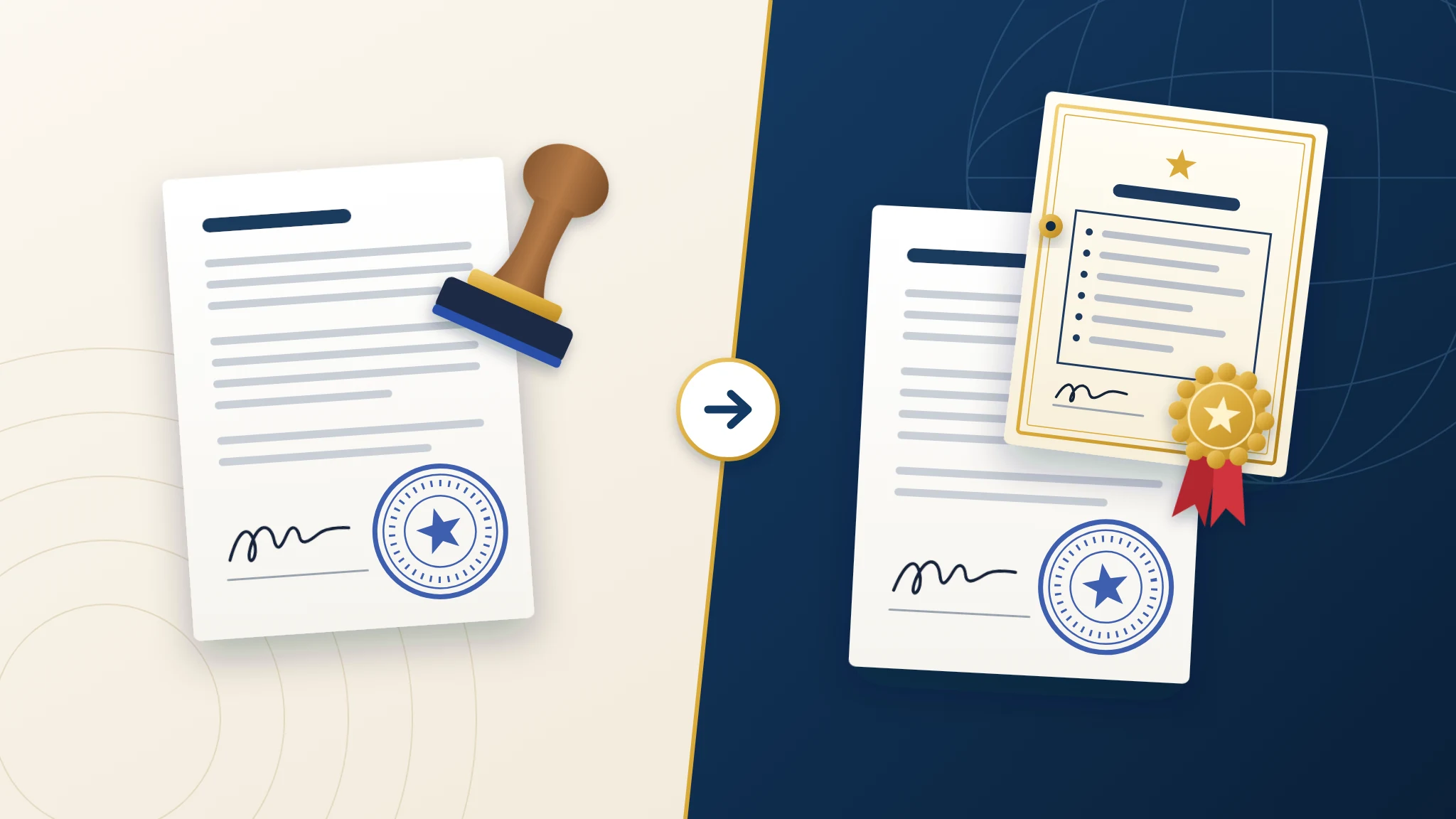
Notarization and apostille are two different steps, done by two different authorities, in a fixed order. Here is the difference, which documents need both, and how to get it right the first time.
Have your document ready?
Get it notarized online in about 10 minutes — $25, 24/7, no account needed.
Notarize now — $25Key Takeaways
- •Notarization and apostille are two separate steps performed by two different authorities, in a fixed order.
- •A notary verifies the signer's identity and signature; an apostille authenticates the notary's seal, signature and authority for international use.
- •The order is always notarize first, then apostille — a Secretary of State will reject an un-notarized private document.
- •Apostilles are issued by the Secretary of State where the notarization was performed, or the US Department of State for federal documents.
- •Notaron performs remote online notarizations under US state law and does not issue or obtain apostilles.
- •Documents that stay inside the United States need only the notarization; countries outside the Hague Convention require consular legalization instead.
- •For a remote notarization, the apostille comes from the state that commissioned the notary, not the state where the signer was located.
If you need a document to work in another country, you will run into two words that sound like they mean the same thing: notarization and apostille. They don't. They are two different steps, done by two different authorities, in a specific order — and mixing them up is the most common reason documents get rejected at the worst possible moment.
Here is the difference, the correct order, and what to do about it.
What notarization actually is
Notarization is the first step. A commissioned notary public verifies your identity, watches you sign (or acknowledges your signature), and applies their official seal and signature to the document. The notary is certifying three things: you are who you claim to be, you signed willingly, and you appeared to understand what you were signing.
That is the whole job of the notarial act. It says nothing about whether the document is true or legal — only that the signature on it was properly witnessed.
A notarization can happen in person or over live video. A remote online notarization (RON) session works the same way as a traditional one — ID verification, a live appearance, a witnessed signature, a tamper-evident digital seal — except you and the notary meet on camera instead of across a desk. Notaron performs remote online notarizations under US state law: sessions start at $25 (one signer, one notarization included; additional seals $5, additional signers $10, witnesses $15), run 24/7 with no appointment and no account needed, and you are charged only when the notarization completes. The full list is on the pricing page.
What an apostille actually is
An apostille is the second step, and it has nothing to do with witnessing your signature. It is a certificate issued by a government authority — in the United States, the Secretary of State of the state where the notarization was performed — that authenticates the notary's seal and signature for international use.
Think of it this way: the notary vouches for you; the apostille vouches for the notary.
Apostilles exist because of the Hague Apostille Convention, the treaty that lets member countries accept each other's public documents. If both the US and the receiving country are Hague members, an apostille from the Secretary of State is generally all the authentication the document needs. The Philippines, for example, is a Hague member — which is why the standard route for a US-notarized document headed to Manila is notarize in the US, then apostille, then send (see our Philippines guide).
One thing to be explicit about: Notaron does not issue apostilles and cannot obtain one for you. Apostilles come only from the Secretary of State (or, for federal documents, the US Department of State). Notaron's role is the notarization itself — the step the apostille then authenticates.
The difference at a glance
| Notarization | Apostille | |
|---|---|---|
| Who does it | A commissioned notary public | The Secretary of State (state documents) or US Department of State (federal documents) |
| What it certifies | Your identity and your signature | The notary's signature, seal, and authority |
| When it happens | First | Second — after notarization |
| What you get | A sealed, signed document | An apostille certificate attached to that document |
| Why it exists | Fraud prevention at signing | International acceptance of the notary's act |
The order matters: notarize first, then apostille
This is where most people go wrong. The order is fixed, and it only runs one direction:
- Notarize the document. A special power of attorney, an affidavit, a consent letter — signed and sealed by a notary.
- Submit the notarized document to the Secretary of State in the state where the notarization was performed, with their apostille request form and fee.
- Receive the document back with the apostille certificate attached, and send it abroad.
An apostille authenticates a notarial act. If there is no notarial act yet, there is nothing to authenticate — a Secretary of State will reject an un-notarized private document. (The exception: documents the state itself issues, like a certified birth certificate, already carry state authority and generally go straight to the apostille step without a notary involved.)
Which documents need both
You need the notarize-then-apostille sequence for private documents signed for use in a Hague member country. The usual cases:
- Special powers of attorney for property, banking, or legal matters abroad
- Affidavits — of loss, of support, of single status
- Parental travel consents for minors
- Adoption and immigration paperwork
- Corporate documents — board resolutions, certificates of good standing (some go through the state directly)
- Diplomas and transcripts (often notarized as true copies first, depending on the school and state)
For what to prepare before the notary session, see documents bound for an apostille.
You do not need an apostille for a document that stays inside the United States. A notarization alone is the complete act domestically. The apostille only enters the picture when the document crosses a border into a Hague member country.
What if the country isn't in the Hague Convention?
Then there is no apostille — there is consular legalization instead, and it is a longer chain. The typical sequence: notarize the document, get it authenticated by the Secretary of State, then authenticated by the US Department of State, then legalized by the foreign country's embassy or consulate in the US. Each step certifies the previous one. Confirm early which process your destination country requires — your country's Hague membership status is the single fact that decides which path you take.
Apostille process, fees, and turnaround vary by state
There is no single national apostille office for state documents. Every Secretary of State runs its own process, and they differ in ways that matter:
- How to submit: in-person counter service, mail, and in some states online portals or drop-off.
- Fees: a per-document fee set by the state — confirm the current amount on the Secretary of State's site before you send anything.
- Turnaround: anywhere from same-day counter service to several weeks by mail, depending on the state and the season.
Confirm the current procedure, fee, and turnaround directly with the Secretary of State in the state where your notarization was performed. If you had the document notarized in Texas, Texas issues the apostille — not your home state, not the state where the document will be used.
The remote-notarization angle
A remotely notarized document carries the same legal effect as one signed at a notary's desk. For the apostille step, submit the finished document to the Secretary of State of the state where the notarization was performed, exactly as with a paper notarization.
Two practical notes. First, confirm with the Secretary of State whether they issue apostilles for electronically notarized documents — most do now, but some states still want a paper printout of the electronic record. Second, the apostille follows the notary's state, not the signer's location: Texas-commissioned notary, Texas apostille — even if the signer was sitting in California.
Start with the notarization
If your document is headed abroad to a Hague member country, the sequence is: confirm what the receiving party accepts — then notarize, apostille, send. Notaron handles the first step — a remote online notarization under US state law, starting at $25 per session, 24/7, no appointment, no account, charged only when the notarization completes. Start a session.
Frequently Asked Questions
Can Notaron issue my apostille?
No. Notaron performs remote online notarizations under US state law. Apostilles are issued only by the Secretary of State in the state where the notarization was performed (or the US Department of State for federal documents). Complete your notarization with Notaron first, then submit the notarized document to the Secretary of State for the apostille.
Do I need an apostille or consular legalization?
It depends on the destination country. If it is a member of the Hague Apostille Convention, you generally need an apostille. If it is not a member, you need consular legalization — a longer multi-step chain through the Secretary of State, the US Department of State, and the foreign embassy. Check the country's Hague status before you start.
Can I get an apostille for a document notarized online?
Generally yes — a remote online notarization is a valid notarial act, and most Secretaries of State issue apostilles for electronically notarized documents. Confirm the current procedure with the Secretary of State where the notarization was performed, since some states have specific requirements for electronic records.
How long does an apostille take?
It varies widely by state: same-day counter service in some states, several weeks by mail in others. Check the current turnaround with the issuing Secretary of State before you plan around a deadline, and build in buffer for mailing time in both directions.
Does every notarized document need an apostille?
No. A notarization is complete on its own for any domestic use. You only need an apostille when the document will be used in another Hague member country. If the document never leaves the US, stop at the notarization.
Which state issues the apostille if I notarize remotely?
The state where the notarization was performed — meaning the state that commissioned the notary — not the state where the signer was sitting. If your Notaron session was performed by a Texas-commissioned notary, the apostille comes from the Texas Secretary of State.
About the author
Notaron
The Notaron editorial team covers remote online notarization law, cross-border document authentication and apostille procedure for individuals and businesses. Notaron is a US remote online notarization platform connecting signers with commissioned notaries over secure video.
Ready to get it notarized?
- Get a document notarized online — $25 About 10 minutes, 24/7, no account needed.
- What an online notary costs $25 per notarization, every add-on listed, nothing charged until it is done.
- Notarize a document online What can be notarized online, by document type.