
Florida Remote Online Notarization for Title Companies: The Complete Compliance Guide
What Florida title companies need to run compliant RON closings: Chapter 117 requirements, remote witness rules under § 117.285, identity proofing options, underwriter approval, and a seller-side workflow that prevents failed sessions.
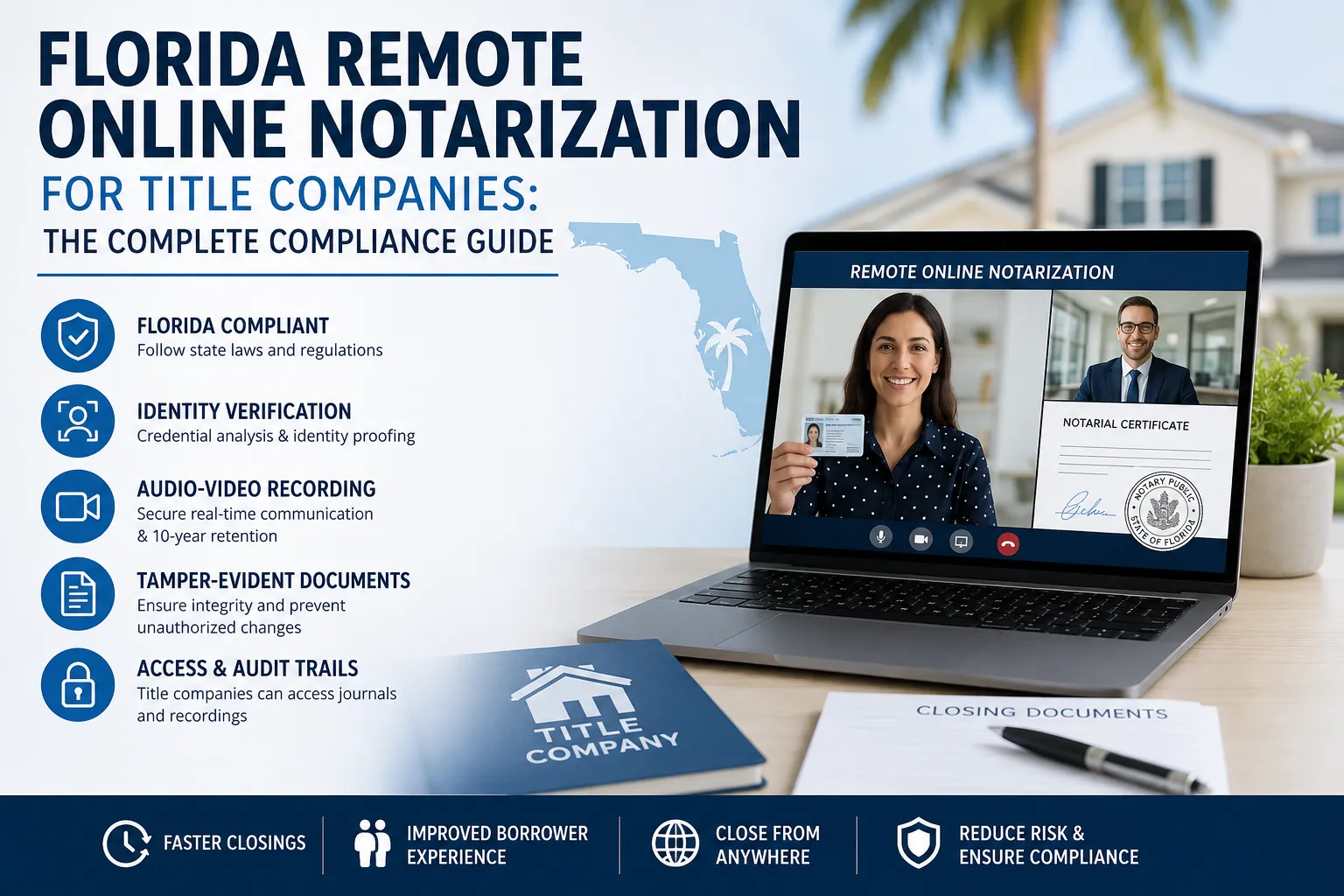
Key Takeaways
- •Florida RON is governed by Florida Statutes §§ 117.201–117.305, in effect since January 1, 2020
- •Identity proofing can be satisfied by biometric verification or KBA — Florida does not mandate KBA
- •Deeds requiring two witnesses can be executed remotely under § 117.285 with verified remote witnesses
- •Remote witnesses must verbally confirm they are physically located in the U.S. at the time of witnessing
- •Underwriter platform approval is separate from statutory compliance — confirm it before scheduling
- •Estate documents like POAs trigger additional screening questions under § 117.285(5)
- •Every session produces a retained video recording and electronic journal for evidentiary protection
Florida authorized Remote Online Notarization on January 1, 2020, under Chapter 2019-71, Laws of Florida — now codified at Florida Statutes §§ 117.201–117.305. Six years in, RON is no longer an emergency workaround. It is how Florida title companies close mail-away files, out-of-state sellers, and split-signer transactions without waiting on overnight packages.
But Florida''s RON framework has specific requirements that don''t exist in other states, and a closing that misses one of them — a screening question, a witness verification step, an underwriter sign-off — creates a document your underwriter may not insure. This guide covers what title and escrow professionals actually need to know, with statute citations throughout.
What Florida Law Requires for a Valid RON Session
Under § 117.265, an online notarization requires:
A Florida-commissioned online notary. Not every Florida notary can perform RON. The notary must hold an active commission, complete a state-approved RON course, register as an online notary with the Department of State, carry a $25,000 bond and $25,000 errors and omissions policy, and contract with an approved RON service provider whose technology meets Chapter 117 and Rule 1N-7.001, F.A.C. standards. Consumer video apps — FaceTime, Zoom, Google Meet — do not qualify.
Watch:
https://www.youtube.com/shorts/FBNbjrFzHBU
Identity verification beyond a webcam glance. Unless the notary personally knows the signer, Florida requires all three of the following (§ 117.265(4)):
- Remote presentation of a government-issued photo ID
- Credential analysis — automated verification that the ID is authentic
- Identity proofing — a third-party affirmation of identity, which under § 117.201 may be performed through biometric verification (such as a live selfie matched against the presented ID) or knowledge-based authentication (KBA), the legacy five-question quiz drawn from public records
This distinction matters operationally. KBA depends on the signer having a U.S. public-records footprint — which is why older RON platforms built on KBA effectively shut out foreign sellers. Biometric identity proofing removes that dependency: the statute even permits a foreign passport without a U.S. stamp as the identification credential for a signer located outside the United States (§ 117.201(6)). If your current platform still forces KBA on every signer, that is a platform limitation, not a Florida requirement.
A recorded, retained session. The entire audio-video session is recorded and retained, and an uninterrupted, unedited copy must be producible under subpoena or lawful request (§ 117.285(6)). For title companies, this is a feature, not a burden — you get evidentiary protection an ink signing never provided.
Remote Witnessing: Florida''s § 117.285 Advantage
Seller conveyance documents in Florida — deeds in particular — require two witnesses. This historically killed remote closings: even if you could notarize remotely, you couldn''t witness remotely.
Florida solved this. Under § 117.285, supervising the witnessing of an electronic record is itself a notarial act, and witnesses may appear either physically with the signer or remotely through the same audio-video technology. The requirements differ by configuration:
Remote witnesses must have their identities verified using the same § 117.265(4) procedures as the principal (ID + credential analysis + identity proofing), must observe the signing in real time, and must verbally confirm on the recording that they are physically located in the United States or a U.S. territory at the time of witnessing.
Physically present witnesses (with the signer) must confirm their identity by stating their name and current address on the recording.
For practical scheduling: a deed signing with two remote witnesses means three people clearing identity proofing, not one. Sessions run longer and failure risk compounds — especially on KBA-based platforms. Where the seller can produce two witnesses in the room with them, the session is simpler — and under § 117.285(5)(k), the enhanced screening questions for sensitive documents do not apply when two witnesses are physically present with the principal.
Note on estate documents: Wills, revocable trusts with testamentary aspects, powers of attorney with certain authorities, and health care directives trigger additional statutory screening questions and a vulnerable-adult warning under § 117.285(5). These rarely appear in a standard closing package, but when a POA shows up in your file, your RON platform and notary need to handle the extra steps or the instrument is open to challenge.
What Your Underwriter Requires (And the Statute Doesn''t Say)
Statutory compliance is the floor, not the finish line. Every major Florida title insurance underwriter maintains its own list of approved RON platforms and its own conditions for insuring RON-executed documents. Before you schedule a single session:
- Confirm your underwriter has approved the RON platform you intend to use. Approval is platform-specific, not generic. An otherwise valid notarization on a non-approved platform can leave you unable to issue the policy.
- Confirm out-of-state notary rules. Florida property can be conveyed using a RON notary commissioned in another state — but the execution must still satisfy Florida law, and because other states'' identity proofing standards differ from Florida''s, underwriters frequently require additional identity authentication or pre-approval for out-of-state RON. When the seller is abroad or the notary is out-of-state, get written underwriter sign-off before the session.
- Confirm lender acceptance on financed deals. Most national lenders accept RON, but per-lender and per-county recording acceptance should be verified during title commitment, not at the closing table.
The Seller-Side RON Workflow That Actually Works
From two decades in escrow operations, here is the sequence that prevents failed sessions:
- Intake screening. Confirm every signer''s ID type and which identity proofing method applies — biometric verification handles foreign sellers and thin-file signers that KBA-only platforms reject. Identify any POA, trust, or estate documents in the package that trigger § 117.285(5).
- Underwriter confirmation. Platform approved, out-of-state issues cleared, in writing.
- Witness planning. Decide remote vs. physically present witnesses per signer. Book witness-as-a-service if the seller cannot supply their own.
- Tech check. Signer completes a device and connection test before signing day. Most "failed RON sessions" are bandwidth problems discovered live.
- Session. Notary completes credential analysis and identity proofing, witness verification, recorded signing, and applies the electronic seal and digital certificate.
- Post-closing. Electronically sealed documents move to e-recording; the session recording and electronic journal are retained per § 117.245.
Compare this to a mail-away: no overnight packages, no missed-signature do-overs, no two-day turn. A multi-signer file with sellers in three states closes in one session.
Running Florida RON Closings on Notaron
Notaron is an approved Remote Online Notarization provider in Florida, built for exactly this workflow: Chapter 117-compliant sessions with credential analysis and identity proofing, § 117.285 remote witness supervision with witness invitations and witness-as-a-service, full session recording, and an electronic journal with a cryptographically chained audit trail. Schedule a Florida RON demo or see how Notaron works for title companies.
Frequently Asked Questions
Can a Florida RON deed be recorded like any other deed?
Yes. A properly executed online notarization has the same legal effect as a traditional notarization, and Florida county recorders accept electronically notarized documents. Confirm e-recording specifics with the county in your file.
Does the seller have to be in Florida during the session?
No. The signer can be anywhere; the notary must be physically in Florida, or be an out-of-state online notary subject to underwriter conditions. Remote witnesses must be in the U.S. or a U.S. territory.
What happens if a signer fails identity proofing?
Under § 117.265(1), if identity proofing cannot be satisfied — or the databases consulted do not contain sufficient information — the notary may not perform the online notarization. On KBA-based platforms this is a common failure for thin-file or foreign signers; biometric verification largely eliminates it. Screen the signer profile at intake and have a fallback ready.
Can a foreign seller use Florida RON?
Yes, with the right identity proofing method. The statute permits a foreign passport without a U.S. stamp as the credential for a signer located outside the U.S. (§ 117.201(6)), and biometric verification does not depend on a U.S. records history the way KBA does. Confirm your underwriter's conditions for foreign-signer RON before scheduling.
Are RON closings more vulnerable to fraud?
The session record cuts the other way. Every Florida RON session produces a retained video recording, credential analysis results, and an electronic journal — evidence that does not exist for an ink signing. Underwriters increasingly treat RON identity verification as a fraud-reduction tool, particularly against seller impersonation schemes targeting vacant land.